AI + Digital Marketing: 7 Ways Businesses Can Get More Customers in 2026
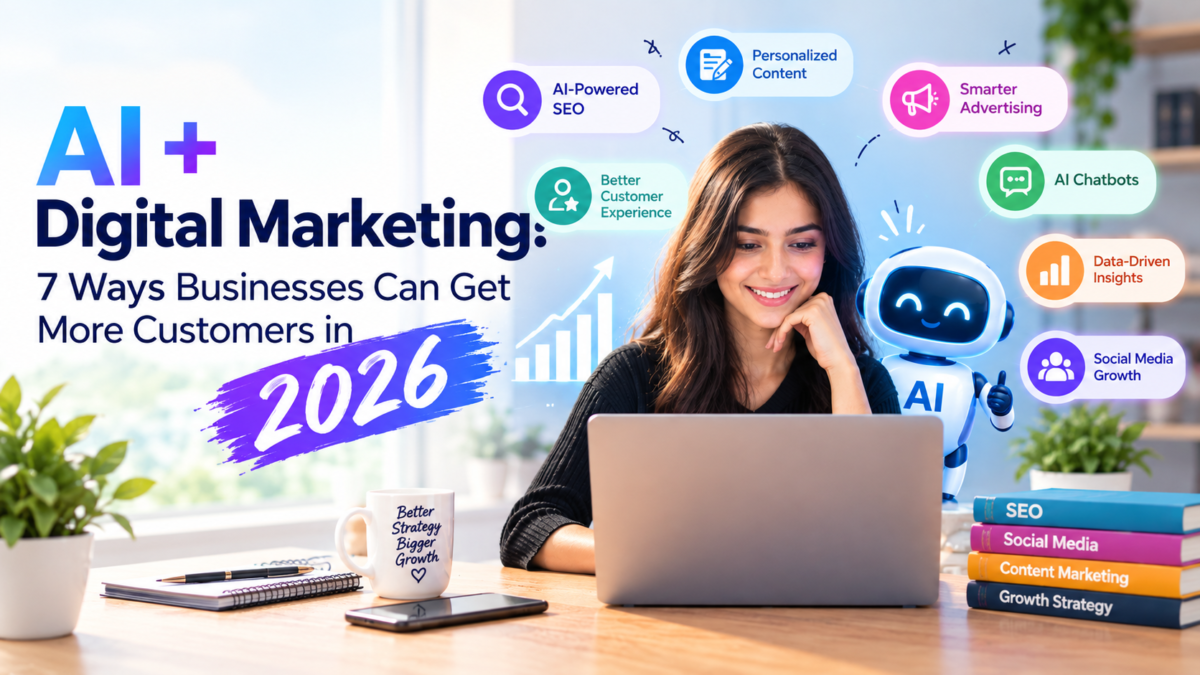
Digital Marketing: 7 Ways to Get More Customers in 2026
Introduction
Digital marketing is changing faster than ever.
In 2026, businesses are no longer using Artificial Intelligence only for generating content or answering customer questions. AI is becoming part of *search, advertising, customer service, content creation, personalization, analytics, and sales*.
Google has introduced more AI-powered experiences across Search, Ads and Analytics, while businesses are increasingly adapting their marketing strategies for AI-powered search and discovery.
But does using AI automatically bring more customers?
*No.*
The real advantage comes from combining *AI technology with a smart digital marketing strategy*.
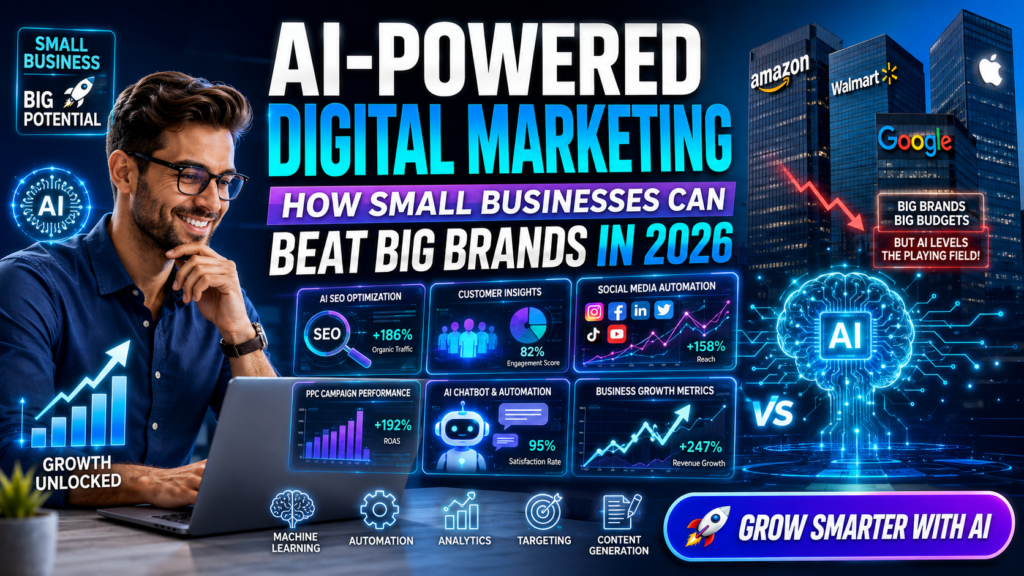
Here are 7 practical ways businesses can use AI + digital marketing to attract more customers in 2026.
—
## 1. Use AI to Create Smarter and More Personalized Content
Customers don’t want to see the same generic message everywhere.
AI can help businesses understand customer interests and create more relevant content for different audiences.
For example, instead of showing the same advertisement to everyone, a business can create different messages for:
* First-time visitors
* Existing customers
* People who abandoned their cart
* Customers interested in a particular service
* People searching for specific products
AI can help marketers analyze customer behaviour and develop content ideas, headlines, social media posts, email campaigns and advertising variations.
However, AI should be used as a *marketing assistant, not a replacement for human creativity*.
The best content combines AI-powered efficiency with human experience, originality and brand personality.
—
## 2. Optimize Your Website for AI-Powered Search
Search is no longer only about typing a few keywords into Google.
People are increasingly asking longer, conversational questions and using AI-powered search experiences to discover information, products and businesses.
Google’s current guidance emphasizes that strong SEO fundamentals and genuinely helpful content remain important even in the AI Search era.
This means businesses should focus on:
* Helpful and original content
* Clear answers to customer questions
* Relevant keywords and topics
* Strong website structure
* Fast loading pages
* Mobile-friendly design
* Authoritative information
* Structured data where appropriate
* Regularly updated content
The goal is no longer simply to *rank on Google*.
Businesses should also aim to become a *trusted source that AI-powered search systems can understand and recommend*.
—
## 3. Make Advertising Smarter With AI
Paid advertising can become expensive when campaigns are poorly targeted.
AI can help marketers analyze large amounts of campaign data and identify patterns in customer behaviour.
Modern advertising platforms are increasingly introducing AI-powered tools for campaign optimization, creative generation, audience discovery and performance analysis. Google, for example, has expanded AI capabilities across Search and advertising products in 2026.
Businesses can use AI to improve:
*Audience Targeting → Ad Creative → Campaign Optimization → Performance Analysis*
Instead of relying completely on guesswork, marketers can use data to understand which audiences, messages and creatives are generating better results.
The result?
*Better marketing decisions and potentially better return on advertising spend.*
—
## 4. Use AI Chatbots to Turn Visitors Into Customers
Imagine a potential customer visits your website at 11 PM.
They have a question.
There is no employee available to answer it.
This is where AI-powered chatbots can help.
AI chatbots can provide instant responses to common questions, explain services, collect enquiries and guide visitors toward the next step.
For example:
*Visitor:* “How much does your digital marketing service cost?”
*AI chatbot:* “Our pricing depends on your business goals and the services you require. Would you like to schedule a consultation?”
This creates a faster customer experience while helping businesses capture leads even outside normal working hours.
However, human support should remain available for complex or sensitive questions.
—
## 5. Turn Social Media Into a Customer Acquisition Channel
Social media is no longer just about gaining followers.
The bigger goal is *turning attention into business*.
AI can help businesses create and manage social media content more efficiently by assisting with:
* Content ideas
* Captions
* Short-form video concepts
* Content calendars
* Audience analysis
* Creative variations
* Performance analysis
But simply posting AI-generated content isn’t enough.
In 2026, when AI-generated content is becoming easier to produce, *originality and authenticity become even more valuable*.
Businesses should combine AI with:
* Real customer stories
* Behind-the-scenes content
* Expert opinions
* Testimonials
* Product demonstrations
* Local content
* Human storytelling
AI can help you produce content faster.
*Your brand should give people a reason to care.*
—
## 6. Use AI Analytics to Understand What Customers Actually Want
One of the biggest advantages of AI is its ability to process large amounts of data quickly.
Instead of looking at hundreds of numbers manually, businesses can use AI-powered analytics to identify trends and potential problems.
For example, analytics can help answer:
* Which marketing channel brings the most leads?
* Which pages do customers visit before contacting us?
* Where are customers leaving the website?
* Which advertisement generates better results?
* Which products or services receive the most interest?
* Which customers are most likely to convert?
Google is adding AI-powered summaries and analysis capabilities to its advertising and analytics ecosystem, making it easier for marketers to identify important performance changes and trends.
The important part is not simply collecting data.
*It’s turning data into better decisions.*
—
## 7. Combine AI With Human Creativity
This may be the most important strategy of all.
AI can generate content.
AI can analyze data.
AI can automate repetitive tasks.
AI can assist with advertising.
But AI doesn’t automatically understand your customers, your brand story or your business vision.
That’s why the strongest digital marketing strategy in 2026 is not:
*AI vs Humans*
It is:
### *AI + Humans*
Businesses can use AI for speed, automation and analysis while marketers focus on:
* Strategy
* Creativity
* Brand building
* Customer relationships
* Storytelling
* Decision-making
This combination can help businesses move faster without losing the human element that makes a brand memorable.
—
# Why AI + Digital Marketing Matters in 2026
The digital landscape is moving from traditional search and advertising toward a more *AI-powered and conversational customer journey*.
Google reports that AI Overviews have become a major part of Search, while AI Mode is expanding how users ask questions and discover information.
For businesses, this means digital marketing needs to evolve.
The brands that succeed will not necessarily be the ones using the most AI tools.
They will be the ones that use AI *strategically*.
—
# Final Thoughts
AI is changing digital marketing, but it isn’t eliminating the need for marketers.
Instead, it is giving businesses new ways to:
*Reach the right audience → Create better experiences → Generate leads → Convert customers → Measure results*
From AI-powered SEO and personalized content to smarter advertising, chatbots and analytics, businesses have more opportunities than ever to grow online.
The key is to start with your *business goals and customers*, and then use AI where it can create real value.
### Ready to Grow Your Business With Digital Marketing?
At *Nandini Smart Solution*, we help businesses build stronger digital strategies using modern marketing techniques, creative content, SEO, social media and data-driven approaches.
Whether you are a startup, local business or growing brand, the right digital strategy can help you reach more people and turn online visibility into real business growth.
*Nandini Smart Solution — Turning Digital Strategies Into Business Growth.*